Tuesday, May 11, 2021
Learn About An Ancient Technology Atlatl Workshop @ Institute For American Indian Studies May 22, 2021
Monday, May 10, 2021
Medicinal Monday - Jimson Weed - A Sacred and Poisonous Herb
Datura stramonium has many common names from Jimson Weed and Thorn Apple to Devil's Weed and Angel's Trumpet. This herb is in the Nightshade family and was used by Native Americans carefully as this plant has powerful effects as well as a long history of use by humans. Native Americans were well aware of its uses long before European contact.
About Datura stramonium
In the same family as mandrake, henbane, and belladonna, this perennial belongs to the alkaloid-rich Nightshade family. The root of the plant is thick, fibrous. The pale yellow to the purplish stem stands erect and leafy. The stems branch off repeatedly and each fork has a leaf and a single white to creamy or purple-colored trumpet-shaped flower that blooms throughout the summer. The coarsely toothed leaves are dark green on the top and a lighter green on the bottom and have a bitter taste. The flowers open at night, emitting a pleasant fragrance. The egg-shaped four-chambered seed capsules can grow up to three inches. They are covered with spines and when mature they split to reveal dozens of small, black seeds. All parts of this plant contain dangerous levels of tropane alkaloids. The risk of a fatal overdose is high especially among recreational users who ingest the plant for its psychoactive effects. Datura stramonium intoxication produces delirium, hallucinations, hyperthermia, and bizarre behavior. The effects can last up to two weeks.
Medicinal and Ceremonial Uses
Datura can be found all over the world and is a sacred herb to nearly all Native American communities. Medicine Men use the hallucinatory power of Datura to manifest divine inspiration and visions that foretold the weakness of their enemies and revealed hidden truths. Some tribes administer a brew containing Datura during ritual dances initiating adolescents into manhood. The Virginia Algonquian peoples use this in an ancient coming of age ritual, the huskanawing ceremony.
Medicinally the Cherokee use a poultice of wilted leaves to treat boils. They also smoked the leaves to treat asthma. The Delaware, Rappahannock, and Mohegan use a poultice of leaves to treat open wounds and mixed crushed seeds with tallow to treat piles. A poultice of leaves mixed with tallow was also applied to the chest and to bruises. The leaves were also applied externally to horses to treat sores or bruises. The Iroquois considered the seeds poisonous.
Did You Know...
The genus name, Datura is derived from the plant's Hindi name.
In the United States, its most common name is Jimson Weed deriving from Jamestown, Virginia, where English soldiers consumed it while attempting to suppress Bacon's Rebellion and spent 11 days in an altered mental state.
Until the onset of the 20th century, a prescription of morphine and scopolamine containing plants such as Datura stramonium was used in surgery and to reduce inflammation and pain. The plant fell out of favor because it could lead to death if taken in high doses and, because of the advent of modern synthetic pharmaceuticals.
Monday, May 3, 2021
Institute for American Indian Studies Launches ReDress Exhibit through May 9 with Special May 7 Program
The ReDress Project is a national movement, started by Jamie Black, Metis that has been embraced by the Institute for American Indian Studies in Washington, Connecticut, and by the town of Washington in honor of Native American women and children that have gone missing or have been murdered in the United States and Canada. This awareness project is symbolically illustrated by the red dresses that will be fluttering in the wind for an ephemeral moment in Washington and Washington Depot on Saturday, May 1, and Sunday, May 2 and can be seen on the grounds of the Insititute through May 9, 2021.
The ReDress Project will also be displayed as a temporary exhibition on the newly developed outdoor installation, Red Trail at the Institute for American Indian Studies on 38 Curtis Road, Washington, from May 1 through May 9. Over 1oo supporters have donated red dresses of various sizes and shapes. These dresses will be displayed along our museum trails and at various locations in Washington Depot to create a visual representation of the missing spirits of these individuals. At the museum, staff and volunteers will be available to answer questions, discuss this serious topic at various age levels, and provide resources for further action.
There is no admission fee to this outdoor installation at the Institute for American Indian Studies. On May 7, at 7 p.m. the Institute is hosting a virtual discussion about the ongoing efforts to raise awareness about the missing and murdered indigenous women and children and Two Spirits, led by Education Director, Darlene Kascak, Schaghticoke, Tribal Nation.
Medicinal Monday - Legendary Salmonberry
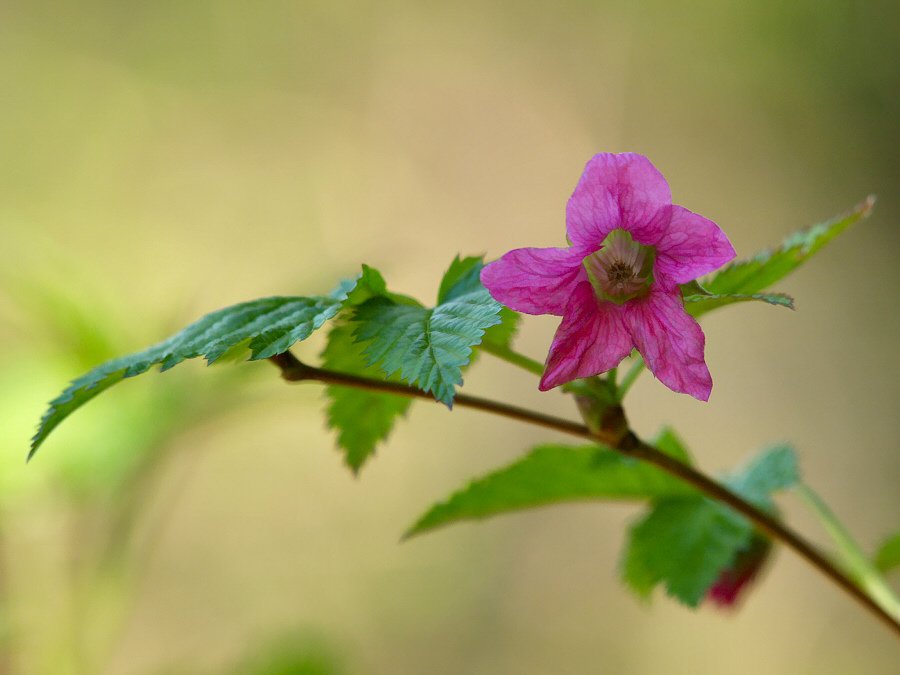
The salmonberry is a species of brambles in the rose family that is native to the west coast of North America from west-central Alaska to California. This bright red fruit is valued for food, medicine, and its role in Native American and First Nation stories.
About the Salmonberry
For centuries these berries have been used by native communities such as the Chehalis, Cowlitz, Lower Chinook, Makah, Quinault, Quileute, Inupiat, and Swinomish. Many Native stories are told about this berry. The Chinooks of the First Nation, for example, told a story about a coyote that was instructed to place these berries in the mouth of each salmon in order to ensure good fishing, which is how this berry got its name. Other stories compare the berries to the red eggs of a salmon. According to anthropologists, the salmonberry plant is a symbol of "respect" among many First Nation Communities of the Pacific Northwest. It is thought that harvesting these berries represents a fulfillment of an obligation for certain clans. In a Makah legend, it is said that if a child stays out past dark, the basket woman will come and take the child and roast him or her for dinner. One night a child named Salmonberry stayed out after dark to see if the basket lady existed. The basket lady appeared and took Salmonberry to her hut to be cooked for dinner!
The salmonberry or rubus spectabilis is a perennial shrub that grows up to 13 feet tall. It has three toothed leaves with larger leaves on either side. The plant resembles the raspberry plant. The flowers have five pink petals and bloom in early summer. The berries look like a large blackberry and ripen from May through July. They thrive under red Adler and can be found in moist forests, in coastal forests, and along streams.
Medicinal, Culinary and Practical Uses
Native American people eat the young shoots of this plant in the spring. Traditionally the berries are eaten with salmon or mixed with oolichan grease from a candlewood fish (that resembles a smelt) or salmon roe. The berries are also eaten as an accompaniment to smoked salmon.
The Kaigani Haida people make baskets with the salmonberry plant. Some communities use the leaves of the plant to wipe fish down. The Makah make tobacco pipes from salmonberry brambles.
The bark and leaves have an astringent property and are made into a tea that is taken for diarrhea or dysentery. The Quileute have a spiritual and ceremonial connection to the salmonberry coinciding with the time when the first shoots appear and, then again, when the berries appear. The Bella Coola make a decoction of the root to treat stomach troubles and the Kwakiutl apply powered bark to burns. The Makah make a poultice of bark to treat sores and toothaches, and the Quinault, use a decoction of bark to lessen labor pains.
Did You Know...
Traditionally women were responsible for the harvest of the salmonberry.
Swainson's Thrush is also called the salmonberry bird because it arrives every May when the berries begin to ripen.
Today it is widely grown as an ornamental plant because of its beautiful flowers.
Traditionally the berries were not dried because of their high moisture content.
Today, due to refrigeration and pectin, jams and jellies are made with the berries.
Monday, April 26, 2021
Medicinal Monday... Wild Comfrey - Blue and Rare
This beautiful blue flowering plant is in the borage family and is native to the Eastern United States including Southern New England. It makes its first appearance in Connecticut in the spring. It was formerly far less rare in New England and Connecticut than it is today.
About Wild Comfrey
Andersonglossum virginianum known as wild comfrey is usually found in the forest in rich soil, on steep slopes, in New England uplands, and in recently burned areas. It is dependant on humidity, low temperature, and low competition. It has adapted the unusual ability to survive fire because it helps to eliminate competition and increases the light this plant gets so it can nurture itself. It is an unbranched perennial that stands erect and has fine hairs on its leaves and stem. The leaves are simple and not separated into leaflets. They are denser at the lower end of the stem and get smaller as they go up. When blooming this plant has a light blue flower cluster, each flower has five round petals on separate stems. The flowers at the base of the stem develop first. The roots are thick and cord-like. The fruit is dry and does not split open when ripe. Wild Comfrey is in bloom from May to June and produces fruit from July to August. The flowers produce four grayish-brown seeds that stick to animals.
Medicinal Use
The Ojibwa use this plant as an analgesic. They burn the plant on hot coals and inhale the fumes to treat headaches. Wild Comfrey has also been used to treat wounds and to flush out any internal digestive disorders and respiratory infections. The Cherokee use the root compound to treat cancer. A tea is made from the root and taken to treat itches and urinary problems and is also used as a sedative.
Did You Know...
It is sometimes called blue houndstongue. It gets this name from the appearance of its leaves that resemble a dog's tongue.
This plant should not be taken internally in great quantities because it can cause liver damage.
It was formerly placed in the genus Cynoglossum, it was transferred to the genus Andersonglossum in 2015.
In Connecticut, Wild Comfrey is considered extremely rare.
Tuesday, April 20, 2021
Ojibwa Story of the Lady Slipper
According to an Ojibwa Legend, a village was decimated by a dreaded disease that even killed the medicine man. To deal with this crisis the chief asked his messenger to go to a nearby village to ask for medicine. This trip was very difficult especially in the winter without moccasins. The messenger fell ill before he was able to go. The messenger's wife, Koo-Koo Lee decided to go fetch the medicine instead to save the life of her husband and those members of her village that had been struck with this illness.
Monday, April 19, 2021
Medicinal Monday - Delicate and Endangered - PinkLady Slippers
About the Pink Lady Slippers
Did You Know...
If you pick a Lady Slipper it will not rejuvenate. This plant has less than a 5% transplant rate of success.Some species of Lady Slippers are categorized as endangered in New England.
Regulations regarding picking Lady Slippers vary from state to state but in general, picking these precious flowers is discouraged and in some states illegal.