Monday, December 13, 2021

Medicinal Monday...Sweet Mountain Cicely

Sweet Mountain Cicely commonly called sweetroot is widely used among Native American communities medicinally and as a source of food. It even has several interesting veterinary applications.  Sweet Mountain Cicely is found in the boreal zones of North America from Alaska to Newfoundland and extends as far south as South Dakota and west to the mountain ranges of the Pacific Northwest. It is also found in northern New England but does not grow in Connecticut, Rhode Island, or Massachusetts. In South America, it is found in the forests of Argentina and Chile.

About Sweet Mountain Cicely

This is an aromatic perennial herb, that is in the parsley family. It produces a branching stem that can grow over a foot high. The roots of this plant are massive and grow deep in the ground. All parts of the roots are edible and have a sweet taste. The bright green leaves are plentiful and are divided into three-lobed leaflets that unfurl up to three inches in length. The plume of foliage resembles ferns. When in flower Sweet Mountain Cicely can grow up to three feet tall, but most of the time it is low and close to the ground. It prefers well-drained soil and shade. The umbel flower cluster is made up of many tiny white flowers at the tip of the stem. The narrow, elongated fruit is ribbed and bristly. This plant is insect-pollinated with its seeds distributed by animals.  

Medicinal Uses

The Blackfoot and Ojibwa make a hot tea from the roots and took it to treat colds and sore throats. The Cheyenne chewed the roots as a stimulant and to treat colds. They use an infusion of pulverized leaves and stems to treat bloated stomachs and kidney trouble. The Karok chewed the roots for headaches and would place them under a pillow to prevent sickness. They would also use an infusion of roots in a bath for a person that was grieving. The Kwakiutl use the seeds and roots as an emetic. The Kawalisu use the roots to treat colds and mash the entire plant and use it as a wash to treat fleas. The Chippewa make a decoction of the root and would gargle with it to treat sore throats. They also make a poultice from the root and use it to treat ulcers. The Menominee and the Meskwaki make a decoction of the root and use it as an eyewash for sore eyes. 

Veterinary Uses

The Blackfoot put the roots in the mouth of a mare to keep her in good condition for foaling. The Chippewa use a decoction of the roots as a nostril wash for dogs to increase their sense of smell. The Meskwaki grate the root of this plant and mix it with salt to treat distemper in horses. The Omaha use the root to attract horses so that they could catch them.  The horses are fond of the root and when the roots were held out to them, they would come running making them easy to catch.

Food and Love Medicine Uses

The Karaok, Miwok, Okanagan, Thompson, and many other Native American communities would eat the young tops of this plant as greens. Many would also use the thick aromatic roots as part of their diet. The Isleta boiled the roots and stems to make a pleasant-tasting beverage.

When the Karaok saw this plant where they had never seen it growing before, they considered it a good luck charm. The Swinomish chewed the roots because they believed they were a powerful love charm. 

Did You Know...

Sweet Mountain Cicely is used in butterfly gardens.

Young seedpods taste like Good and Plenty candy.

This plant looks a bit like its cousins the poison and water hemlocks.

Sweet Mountain Cicely is rich in nectar and attracts honeybees.


Monday, December 6, 2021

Medicinal Monday...Red Baneberry

Native Americans respect and understand the plants that they live with. Red Baneberry for example was used as a poison, in ceremonies, and to treat a variety of ailments. It is this type of expertise and understanding of the natural world and how to prepare a plant as a medicine or as a poison that is amazing.

About Red Baneberry

This is a herbaceous plant that is usually found growing by streams, along rock slopes, and interspersed among hard-wood and mixed-wood forests. It prefers mineral-rich moist soil and is found throughout New England. It extends as far north as Canada and as far west as Oregon. This erect growing perennial can reach three feet in height and has a hairless stem with alternately arranged leaves, that are lobed and sharp-toothed. It spreads by rhizomes. In late June, the plant blooms with clusters of small white flowers that quickly die off leaving red fruit that ripens in July and August. This red fruit is poisonous to eat.

Medicinal Uses

The Algonquian people use the root of this plant to treat several ailments. A decoction is made by boiling the root of the plant and use it to treat coughs, colds, rheumatism, and emaciation. They also use it to purify the blood and as an analgesic. Men of the Ojibwa ate small pieces of the root to cure stomach pain. The Algonquians use a decoction of the root in childbirth to relieve pain, stop bleeding, and stimulate lactation.

Hunting Use

A potent poison can be made from the red fruit of this plant. As a member of the buttercup family, the fruit contains the toxin ranunculin, often found in this family. When exposed to the toxin there is an intense burning sensation followed by reddening of the skin and in severe cases, blistering. Algonquian hunters coat their arrows with the juice of this berry that when introduced intravascularly, the toxin, ranunculin, leads to circulatory failure and death. 

Did You Know...

Other names for Red Baneberry are Red Cotash and Herb Christopher.

The Cheyenne celebrate the plant's qualities by using the root in ceremonies. 

The scientific name of this plant is Actaea rubra.

If the berries of this plant are ingested it affects the nervous system. European species have fatally poisoned children. Symptoms include burning of the mouth and throat, salivation, severe stomach cramps, headache, diarrhea, dizziness, and hallucinations. 

Toxicity depends on a person's height, weight, age, and individual susceptibility. 

This plant is sometimes confused with mountain sweetroot, however, Red Baneberry lacks the strong anise-like scent of mountain sweetroot.


Monday, November 29, 2021

Medicinal Monday...Tall Blue Lettuce!

The first thing I wondered... when I saw Tall Blue Lettuce was ... is it edible?  And, yes, in fact, the leaves of this plant are edible, but their taste is bitter resembling the tang of dandelion leaves. It is best to eat the leaves when young when they are less bitter. In addition to eating tall blue lettuce, Native Americans found several medicinal uses for this striking-looking plant. 

About Tall Blue Lettuce

Lactuca biennis or Tall Blue Lettuce is a biennial herb in the dandelion family.  It is native to New England and has spread over much of the United States and Canada. It can grow up to thirteen feet from a taproot. The toothed leaves are deeply lobed and grow all along the light green or reddish-green stem that sometimes has purple streaks with sparse white hair. The stem (and roots) when broken has a milky white juice. The top of the stem has a multi-branched head with many clusters of flowers. The flowers are whitish to light blue ray florets and bloom from July - October. The fruit is mottled containing one seed that has a tawny-brown fluffy pappus attached to it for wind distribution. Tall Blue Lettuce can be found growing in meadows, fields, and at the edges of forests.


Medicinal Uses

The milky white substance found in the stem and the roots of this plant is thought to have a soothing sedative effect. This milky sap is called lactucarium and is medically the strongest when the plant is flowering. The Bella Coola used made a decoction of the root to treat body pain, diarrhea, vomiting, and heart trouble. The Ojibwa made an infusion of this plant to ease lactation. They also used this plant to attract a deer to them for a close shot.


Did You Know...

Historically this plant has been used to ease anxiety, induce sleep, and as a mild hypnotic leading to its nickname, poor man's opium.

The genus Lactuca is applied to the lettuce family and refers to the milky juice of the stem and root.

The name biennis refers to this plant being biennial.

There are five species of wild lettuce in North America, including Canadian, Florida, Louisana, and Prickly lettuce.

Monday, November 22, 2021

Medicinal Monday - White Turtlehead

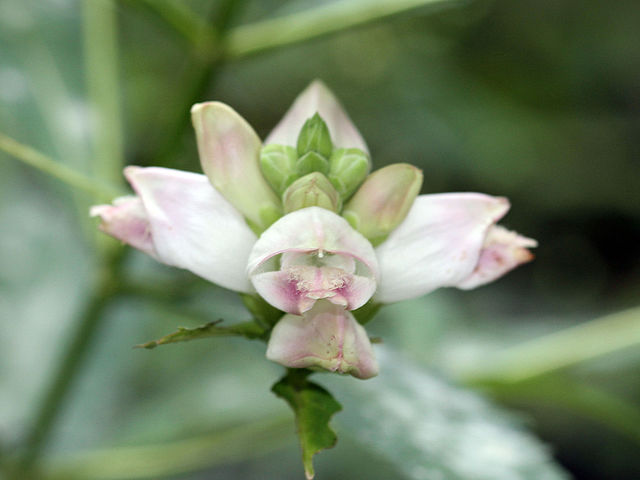
Native to North America, Chelone glabra or white turtlehead is a beautiful flowering plant whose native range from Georgia to Newfoundland also encompasses Connecticut. Its common name comes from the fact the flower petals are thought to resemble the head of a tortoise. Native Americans knew the medicinal and health benefits of this plant and used it to treat several ailments.


About White Turtlehead

This flowering herb can be found in bogs, on the edges of streams and rivers, and in moist woodlands.  There are only four species of this plant whose classification in the past has been controversial. Recent DNA studies have put this plant in the Plantaginaceae (plantain) family, formerly it was in the snapdragon family. This plant has simple lance-like leaves that are hairless and finely serrated along their margins. They grow off of stout upright stems. This partly shade-loving plant can grow up to three feet high and prefers moist to wet rich, humusy soil. It spreads by a taproot and rhizomes. The central stem ends in a dense spike of white flowers that grow up to six inches in length, blooming from top to bottom in the late summer and fall. The tubular flowers are white, sometimes tinged with pink, and have a faint tea-like scent. Many people think that they resemble snapdragons. The seeds are in a wing-like capsule that floats on the wind.

Medicinal Uses

Flowers were used as a method of birth control by the Abenaki people. The Algonquin made tea from the roots and cedar bark to treat a variety of ailments. The Cherokee made an infusion of the flowers and used it to treat worms. This infusion was also taken as a laxative. The plant was used for blood purification and as a treatment for eczema, dermatitis, and chronic rheumatic conditions. The Iroquois drank an infusion of the smashed roots as an anti-witchcraft medicine. The Malecite and the Micmac made an infusion of the entire plant to prevent pregnancy. The Cherokee made an ointment with beeswax or lard and mixed it with parts of this plant and applied it to treat sores. One of the most common uses for white turtlehead was as a tonic for the digestive system.

Did You Know...

Chelone, the genus name was one of the nymphs in Greek mythology who dared to speak poorly of the marriage between Zeus and Hera. For her impertinence, she was turned into a tortoise and condemned to eternal silence and to carry her house on her back forever. In ancient Greek times, the tortoise was a symbol of silence.

This plant is a popular food source for deer, sawflies, and flea beetles.

Other names for this plant include snakehead, turtle bloom, shell flower, and fishmouth.

The Baltimore Checkerspot butterfly caterpillars rely on this plant for food.

Thursday, November 18, 2021

Holiday Market Returns in November and December

The Institute for American Indian Studies located on 38 Curtis Road in Washington is hosting its annual  Holiday Market on Saturday, November 27, December 4, and December 11, and on Sunday, November 28, December 5, and December 12. The market is free and open to the public from 11 a.m. to 4 p.m.; The market is free and open to the public from 11 a.m. to 4 p.m.; visitors can also tour the museum for $10 for adults, $8 for seniors, and $6 for children; members are free.


If you are looking for something really unusual, make sure to stop in at the only Holiday Market featuring Native American-inspired artwork in Connecticut. Here you will find something truly unique for everyone on your list from Native American jewelry and artwork at a variety of price points. A chance to talk with the people that have created the many works of art is an added bonus. 


This iconic market pays tribute to indigenous people across the United States and provides a spectacular opportunity to see Native American-inspired work exhibited and sold. Highlights of the market include the magical sounding flutes handcrafted by Allen Madahbee, Ojibwe. In addition to the one-of-a-kind flutes, Allen is offering beaded moccasins, woodcarvings, rock sculptures, and his inspirational original paintings.

Another vendor, Kim Lewis from Native Visions will be offering an astounding array of Native American Art from Oklahoma and the Southwest including a fine selection of original paintings and prints, Zuni Fetishes, silver jewelry, pottery by Mel Cornshucker, plus Hopi, and Navajo Kachinas. 

A long-time favorite of the Native American Holiday Market, Primitive Technologies will offer a tantalizing array of jewelry including hand-carved flint arrowhead and flint animal necklaces, masks, decorative gourds, carved stone art, containers made out of natural materials, traditional tools, and handmade pottery.


The Museum's Gift Shop will also be open and is brimming with a distinctive collection of Native American jewelry, art, paintings, hard-to-find books, pottery, smudges, games, and much more.


What better way to kick off the holiday season than with a visit to this popular signature event that offers unusual gift items and an immersive cultural experience that celebrates contemporary and traditional Native American inspired art.


Monday, November 15, 2021

Medicinal Monday - Indian Balm

To bring attention to missing and murdered Native American women, this week, Medicinal Monday is featuring Indian Balm noted for its beautiful red flower.  In 2011, the first REDress project took place at the University of Winnipeg and has since traveled to many different cities across North America. Since the launch of the REDress project, the color red has become a symbol for MMIW (missing or murdered ingenious women) across North America. Today, many indigenous supporters and activists frequently wear red clothes and paint a red handprint on their faces at MMIW gatherings. The color red is worn because this is the only color that the Great Spirit sees and by wearing red, they hope to call their missing spirits home.  The REDress movement is haunting and provocative as there is so much silence around the deaths and disappearances of so many native women. 


Native to the deciduous forests of the eastern United States and eastern Canada the plant identified as Indian balm, wake-robin, or the American ground lily is a beautiful flowering spring ephemeral.  Native Americans use this plant medicinally to treat many ailments from a panacea for sick children to the treatment of cancer.


About Indian Balm

The scientific name for Indian balm is Trillium erectum and it can be easily identified by its single whorl of diamond-shaped leaves that seem to clasp the stem of the plant.  Above the leaves is a single crimson flower with three petals that curve backward.  The leaves wither within three weeks leaving a fleshy, berry-like fruit.  In some species, the flower can also be white. The native habitat for this plant in Connecticut is found in wooded areas where it thrives in the mold of rich, moist forests.  The root has the fragrance of turpentine and an astringent taste when first chewed; then it becomes bitter and acidic. Indian balm spreads by a blunt tuber-like rhizome and flowers in Connecticut in a deep red color.


Medicinal Uses of Indian Balm

Traditionally, the root was harvested in late summer after the leaves died down and ground into a number of poultices to use to treat a variety of ailments. Native  Americans use the root of this plant as an aid to lessen pain and difficulty during childbirth, hence the synonym, the birthroot.  It is also used for all types of hemorrhages such as bleeding from the mouth, nose, stomach, or bowels.  Externally, the root is made into a poultice and used to treat tumors, ulcers, and insect bites. The bulbs are ground and then given to children to treat unidentified illnesses and also used as a panacea.  The Cherokee use a poultice to treat putrid ulcers and drink a decoction of this plant to treat coughs. The Iroquois make an infusion of the rhizomes and flowers and use this as a dermatological aid to treat sunburn and pimples.


Did You Know

This lovely flower has a foul smell that attracts carrion flies that act as pollinators. 

Some early herbalists used this plant to treat gangrene.


About The Institute for American Indian Studies (IAIS)
Located on 15 woodland acres the IAIS preserves and educates through archeology, research, exhibitions, and programs.  We have an outdoor replicated 16th c. Algonkian Village and Wigwam Escape and a Museum with temporary and permanent displays of authentic artifacts from prehistory to the present that allows visitors to foster a new understanding of the world and the history and culture of Native Americans. The Institute for American Indian Studies is located on 38 Curtis Road in Washington Connecticut.

Friday, November 5, 2021

Medicinal Monday... the Power of Ribbon Skirts

Spirituality has always been an essential part of healing for most of mankind.  Although healing practices and beliefs vary from Native American community to community, person to person, there is a common thread to most Native American belief systems. The Creator, Mother Earth, Father Sky, or the Great Spirit, among other names, refers to a universal source that is looked to for guidance and healing by both Native American individuals and their communities. Ribbon skirts are an important element in Native American healing and spiritual beliefs that have gained more national recognition in recent years.  

Ribbon Skirt  - Dante Biss-Grayson @ Institute for American Indian Studies 

Ribbon skirts in America recently gained national recognition when the Interior of the Secretary, Deb Haaland wore a traditional ribbon skirt, made by Agnes Woodward/Plains Cree for her swearing-in ceremony in Washington, D. C.  The vibrantly colored skirt worn by Haaland was embellished with imagery of corn and butterflies and covered in colorful ribbons as an expression of cultural pride.  When asked what it meant to Woodward to make the skirt worn by Haaland she said,   “The ribbon skirt today reminds me that I have power and that I carry a responsibility, to teach the future generations that they belong here and that they have the right to take up space however they choose. It’s about taking back the shame that I carried as a young girl. When I wear a ribbon skirt, I am asking people to notice that I am confident in who I am as an Indigenous person, and I am asking them to respect that,” Woodward says. “Really that’s what they mean to me, the shedding of that shame.”

Historically, the first ribbon skirts were made from hides and decorated with natural dyes. After the introduction of silk ribbons by European traders, new skirts were created using new material while keeping their historical meaning and teachings. Woodland Indians used the ribbons as a unique decoration, a form of applique not seen before in Europe. The first recorded instance of ribbon work applique was on a Menominee wedding dress made in 1802. In this way, ribbon skirts show the resilience and pride of Native American culture and the way they adapted to western culture but made it their own by creating the ribbon skirt.

Ribbon Skirt  - Dante Biss-Grayson @ Institute for American Indian Studies 

Culturally and historically ribbon skirts are important as a source of resilience, pride, healing, and empowerment. Recently, they have come to represent causes like missing and murdered indigenous women and girls. Many Native American women have taken to wearing ribbon skirts, every day.  “Women today say it’s like armor – it’s protection,” said Eunice Ketchemonia-Cote, a great-grandmother on the Keeseekoose Reserve north of Kamsack in Saskatchewan, Canada. 

Today there are many reasons to wear ribbon skirts. Tal Tootoosis shares that “It’s teaching them [women] to be empowered and that they already are resilient. Women already have power. A woman is protected because she is a woman. And when you have that understanding you learn boundaries.” These skirts have become a universal symbol of resistance, land and water protection, and a symbol of Missing and Murdered Indigenous Women and Girls (MMIWG). I believe that wearing a ribbon skirt, regardless of tribal affiliation, is an honor."